
What is Form 8962?
Form 8962 is used to calculate and report your Premium Tax Credit (PTC), a benefit for individuals and families who obtain their health insurance through the Health Insurance Marketplace. This form is necessary for anyone who wants to claim the PTC or reconcile advance payments of the credit on their federal tax return. If you received a health insurance subsidy or want to claim the PTC, you'll need to fill out Form 8962. It ensures you receive the correct financial assistance for your health coverage.
What is Form 8962 used for?
Form 8962 is essential for tax purposes, especially for those who've received health insurance through the marketplace. Here's what it's used for:
- To calculate the amount of your Premium Tax Credit.
- To reconcile any advance payments of the Premium Tax Credit.
How to fill out IRS Form 8962

Here are Form 8962 instructions:
01. Part I — Annual and Monthly Contribution Amount:
Name and SSN: Enter exactly as shown on your tax return.
Line A: Check this box only if you're married, filing separately, and qualify for the domestic abuse or spousal abandonment exception.
Line 1: Count yourself, your spouse (if filing jointly), and all dependents you claim. Enter that number.
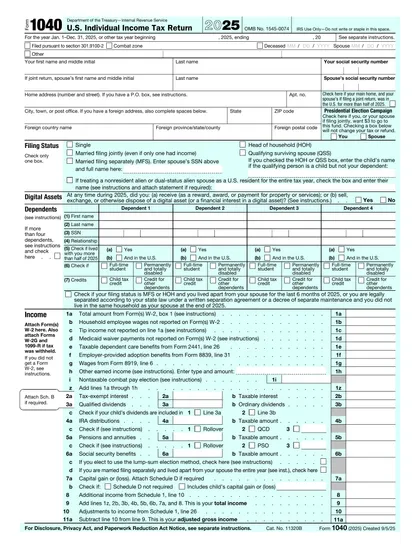
Line 2a: Start with your AGI from Form 1040, line 11a, then add any tax-exempt interest, foreign earned income, and nontaxable Social Security benefits. Use Worksheet 1-1 from the instructions.
Line 2b: Repeat the same modified AGI calculation for any dependents who are required to file their own tax return. Use Worksheet 1-2.
Line 3: Add lines 2a and 2b together. If the result is negative, enter 0.
Line 4: Find your family size in the federal poverty line tables (Table 1-1 for most states, 1-2 for Alaska, 1-3 for Hawaii) and enter the corresponding dollar amount. Check the box matching your state.
Line 5: Divide line 3 by line 4, multiply by 100, and drop everything after the decimal. If the result exceeds 400, enter 401.
Line 7: Find your line 5 number in Table 2 of the instructions and enter the matching decimal figure. For example, if line 5 is 250, enter 0.0400.
Line 8a: Multiply line 3 by line 7 and round to the nearest dollar. This is what the IRS considers your fair annual share of premiums.
Line 8b: Divide line 8a by 12 and round to the nearest dollar. This is your monthly share.
02. Part II — Premium Tax Credit Claim and Reconciliation:
Line 9: If you shared a Marketplace policy with someone now in a different tax family (e.g., divorce, separate filing) or want to use the alternative marriage calculation, check Yes and complete Part IV and/or Part V on page 2 first, then return here. Otherwise, check No.
Line 10: If your Form 1095-A shows the same premiums and SLCSP amounts every month for all 12 months, check Yes and use line 11 (annual). If anything changed mid-year, check No and fill in lines 12–23 month by month.
Column (a): Copy your enrollment premiums from Form 1095-A, column A.
Column (b): Copy the SLCSP premium from Form 1095-A, column B. If blank or incorrect, use the IRS SLCSP lookup tool at Healthcare.gov.
Column (c): Enter your contribution amount from line 8a (annual) or 8b (monthly).
Column (d): Subtract column (c) from column (b). This is the maximum the government will help. If zero or negative, enter 0.
Column (e): Enter whichever is smaller — column (a) or column (d). This is your actual credit.
Column (f): Copy the advance payments already made from Form 1095-A, column C.
Line 24: Total all your column (e) amounts. This is your full-year PTC.
Line 25: Total all your column (f) amounts. This is how much was already paid in advance.
Line 26: If line 24 is larger, subtract line 25 from line 24 — you get extra credit. Enter this on Schedule 3 (Form 1040), line 9. If they're equal, enter 0, and you're done.
03. Part III — Repayment of Excess Advance Payment of the Premium Tax Credit:
Line 27: If line 25 is larger than line 24, subtract line 24 from line 25. This is how much was overpaid to your insurer.
Line 28: Look up your repayment cap in Table 5 of the instructions based on your income level and filing status. Lower incomes have lower caps; above 400% FPL means no cap.
Line 29: Enter whichever is smaller — line 27 or line 28. This is what you actually owe back. Report it on Schedule 2 (Form 1040), line 1a.
04. Part IV — Allocation of Policy Amounts (if applicable):
Lines 30–33: For each shared policy, enter the policy number from Form 1095-A line 2, the other taxpayer's SSN, the months the allocation covers, and agree with the other taxpayer on how to split the premiums, SLCSP amounts, and APTC as percentages. Both taxpayers' percentages must add up to 100%.
Line 34: After completing all allocations, use the allocated amounts when filling in lines 12–23 in Part II.
05. Part V — Alternative Calculation for Year of Marriage (if applicable):
- Lines 35–36: If you and your spouse were both unmarried on January 1, married by December 31, filing jointly, and APTC was paid before your first full month of marriage — enter each spouse's pre-marriage family size and contribution amount for the months before the marriage took effect.
06. Review and Submit:
- Double-check that all Form 1095-A amounts are entered correctly — this is the most common source of errors. Attach Form 8962 to your tax return and file by e-file or mail.
Who is required to fill out Form 8962?
Form 8962 (premium tax credit) is filled out by taxpayers who received advance payments of the premium tax credit (APTC), who wish to claim the PTC, or for whom APTC was paid for an individual they enrolled through the Marketplace. This includes those enrolled in a Marketplace plan who received APTC or are claiming the credit at filing.
The IRS uses Form 8962 to reconcile the credits received with the amount the taxpayer is eligible for, ensuring correct credit allocation.
When is Form 8962 not required?
Form 8962 is not required for individuals who did not receive health insurance through the Marketplace. If you were covered by other insurance, such as an employer's plan, Medicare, or Medicaid, you won't need to complete this form.
Also, if no advance payments of the premium tax credit (APTC) were paid on your behalf and you do not wish to claim the PTC on your return, Form 8962 isn't necessary for your tax return.
When is tax Form 8962 due?
The deadline for Form 8962 is April 15, following the end of the tax year you're reporting for.
If April 15 falls on a weekend or a holiday, the due date is the next business day. This form is part of your federal tax return, so it follows the same submission timeline as your annual taxes.
How to get a blank Form 8962
Our platform offers a fillable Form 8962 (PDF format) ready to complete — no need to download it separately from the IRS website. Simply fill in your details and download the finished form. Keep in mind that PDF Guru helps you prepare and save your form, but does not handle filing it with the IRS.
How to sign Form 8962 online
To sign Form 8962 online with PDF Guru, first complete all required fields. Once you're done, scroll to the signature area and use the built-in e-signature tool to add your signature — you can draw it, type it, or upload an image. After signing, just download your completed form.
Where to file Form 8962?
IRS Form 8962 must be submitted by mail alongside your tax return if you're not e-filing your taxes.
If you're e-filing, attach it digitally to your tax submission.
Other forms you may need with Form 8962
Form 1095-A – Health Insurance Marketplace Statement
Reports your enrollment premiums, applicable SLCSP premiums, and any advance payments of the premium tax credit (APTC) made during the year.
Who uses it: Anyone who enrolled in a qualified health plan through the Marketplace.
Form 1040 / 1040-SR / 1040-NR – U.S. Individual Income Tax Return Your federal income tax return, to which Form 8962 must be completed and attached when filing.
Who uses it: All taxpayers who need to claim the PTC or reconcile APTC.
Schedule 2 (Form 1040) – Additional Taxes Used to report additional taxes, including excess APTC repayment from Form 8962, line 29.
Who uses it: Taxpayers who received more APTC than the PTC they qualify for and must repay the difference.
Schedule 3 (Form 1040) – Additional Credits and Payments Used to report additional credits, including the net premium tax credit from Form 8962, line 26.
Who uses it: Taxpayers whose calculated PTC is greater than the APTC already paid on their behalf.
– Health Coverage Reports minimum essential coverage (MEC) provided by health insurers or government programs such as Medicaid or CHIP.
Who uses it: Taxpayers who need to verify whether they or a family member had MEC, which affects PTC eligibility.
Form 1095-C – Employer-Provided Health Insurance Offer and Coverage Reports whether an employer offered health coverage, whether it met minimum value, and whether it was considered affordable.
Who uses it: Employees determining whether their employer's coverage disqualifies them from claiming the PTC.