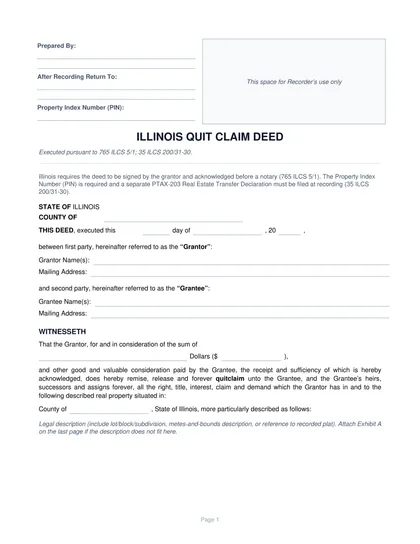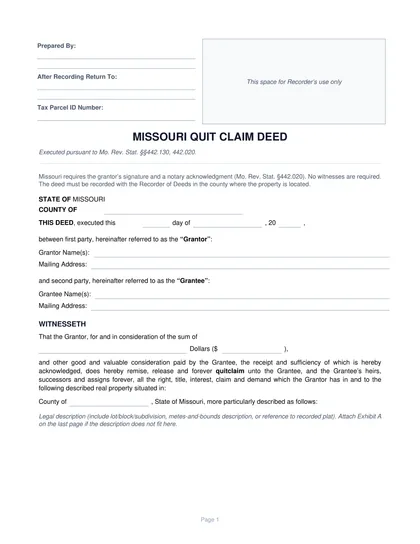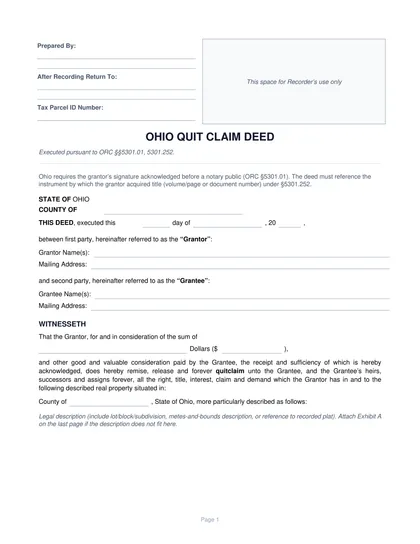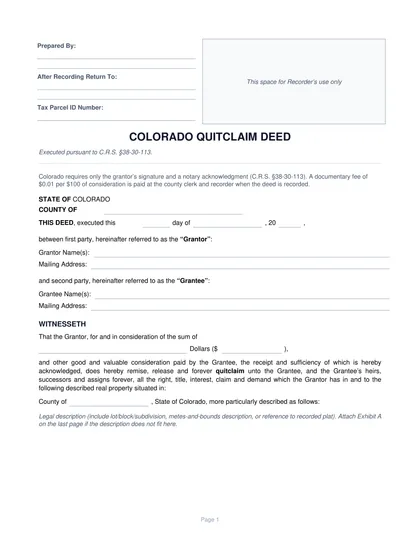

What is a Georgia Quit Claim Deed?
A quit claim deed (also written as "quitclaim deed") is a legal document that transfers whatever ownership interest the grantor (current owner) holds in a property to the grantee (recipient), without any warranty of title. Unlike a warranty deed, a quit claim deed makes no guarantee that the grantor actually owns the property or that the title is free of liens, encumbrances, or competing claims. The grantee accepts the property interest exactly as-is. In Georgia, Georgia law requires the grantor's signature, TWO witnesses, and a notary acknowledgment. (O.C.G.A. § 44-2-14). One witness may be the notary. All four signatures (grantor, 2 witnesses, notary) must appear on the deed. Intangibles Tax Return may be required if a new mortgage is involved.
What is a Quit Claim Deed used for?
Quit claim deeds are most commonly used for:
- Transferring property between family members (parent to child, between siblings) without a sale
- Adding or removing a spouse from a property title during marriage or divorce
- Correcting a name spelling error or legal name change on an existing deed
- Transferring property into or out of a revocable living trust
- Clearing a 'cloud on title' — removing an old, minor claim against the property
- Transferring property between an individual and their LLC or corporation
- Gifting real estate to a family member or charity A quit claim deed is not appropriate for market-value sales to strangers — a warranty deed is standard in those cases.
How to Fill Out a Georgia Quit Claim Deed

- 1
Enter the grantor's full legal name and mailing address (the current property owner).
- 2
Enter the grantee's full legal name and mailing address (the new owner or recipient).
- 3
State the county and state where the property is located.
- 4
Enter the consideration amount (actual sale price, or "$10 and other valuable consideration" for gifts).
- 5
Include the full legal property description from the current deed or county tax records — a street address alone is not sufficient.
- 6
Include the Parcel Identification Number (PIN/APN) if available.
- 7
Sign the deed before a notary public and in the presence of 2 witnesses.
- 8
Have the notary complete the notarial acknowledgment.
- 9
Record the deed with the appropriate county office. Georgia law requires the grantor's signature, TWO witnesses, and a notary acknowledgment
Signing Requirements for a Georgia Quit Claim Deed
Georgia require the grantor's signature before a notary public AND 2 witnesses. The grantee does not need to sign a quit claim deed. If the property has multiple owners, all co-owners must sign to convey the full interest. Transfer tax: Transfer tax: $1.00 per $1,000 of fair market value. Georgia law requires the grantor's signature, TWO witnesses, and a notary acknowledgment. (O.C.G.A. § 44-2-14). One witness may be the notary. All four signatures (grantor, 2 witnesses, notary) must appear on the deed. Intangibles Tax Return may be required if a new mortgage is involved.
When is a Quit Claim Deed Not the Right Choice?
A quit claim deed is not appropriate when the buyer is purchasing at market value and needs a title guarantee — use a general warranty deed or special warranty deed instead. If the property carries an active mortgage, the lender's due-on-sale clause may be triggered by a title transfer — consult the lender before executing. The grantee of a quit claim deed accepts all existing title defects and encumbrances, so a title search is strongly recommended before accepting a quit claim deed in any transaction.
When to Record a Quit Claim Deed in Georgia
Record the deed as soon as possible after signing. Recording with the Clerk of Superior Court establishes constructive notice to the public that ownership has changed. Delaying recording creates a risk: if the grantor sells or mortgages the property to another party before the deed is recorded, the other party's recorded interest may take priority under Georgia's recording statutes. Bring the original signed, notarized deed to the Clerk of Superior Court, pay the recording fee, and any applicable transfer taxes.
Where Can I Get a Georgia Quit Claim Deed Form?
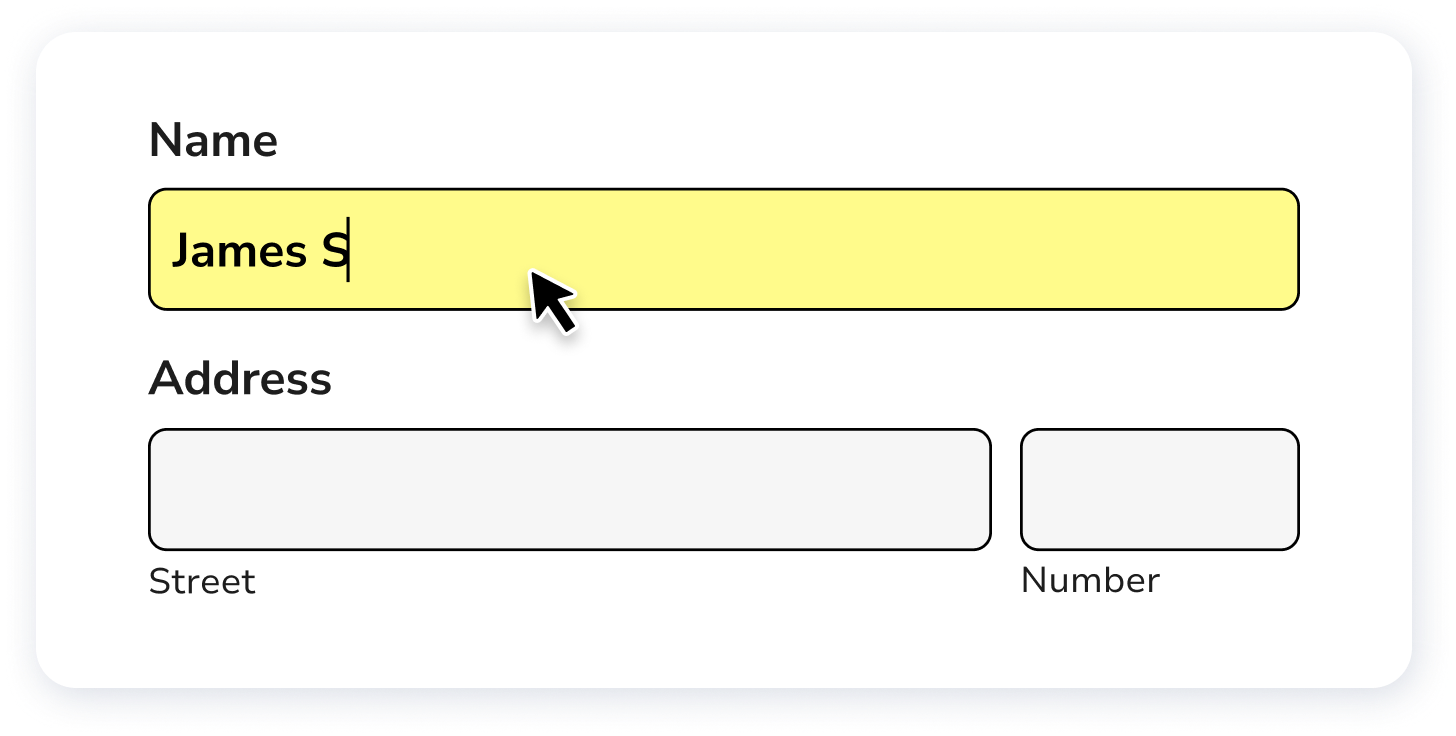
PDF Guru provides a fillable, editable Georgia quit claim deed form preloaded in the online editor. Open the custom template, enter all property and party details, and download a printable PDF ready for signing. You can also obtain quit claim deed forms from the county recorder's office, your local title company, or a licensed real estate attorney. For complex transactions or properties with title issues, consult an attorney before executing a quit claim deed.
How to Sign a Georgia Quit Claim Deed Online
Use PDF Guru to prepare your editable quit claim deed form online — enter all grantor, grantee, and property details, then download the completed document as a printable PDF. Take the printed deed to a notary public and 2 witnesses for in-person signing. In Georgia, both witnesses and the notary must be present simultaneously. Electronic signatures are not accepted for real estate deeds in most states. After signing, return to PDF Guru if any final adjustments are needed before submitting for recording.
Where to Record a Georgia Quit Claim Deed
File the signed, notarized deed with the Clerk of Superior Court in the county where the property is located. Bring the original deed along with any required forms (transfer tax declarations, property transfer affidavits). Transfer tax: Transfer tax: $1.00 per $1,000 of fair market value. The office will stamp the deed with recording information and return the original (or a certified copy). The recorded deed becomes a public record confirming the new owner's interest in the property.