
What is Form 8829?
Form 8829 is used by self-employed individuals to calculate deductions for the business use of their home. It covers expenses such as mortgage interest, insurance, utilities, repairs, and depreciation — and determines how much of those costs you can deduct on your tax return. If you have a home office that you regularly and exclusively use for business, Form 8829 can significantly reduce your tax liability.
To qualify, the space must meet two tests: it must be used regularly for business (not just occasionally) and exclusively for business (not for personal purposes). Exceptions to the exclusive-use test apply to daycare facilities and storage of inventory or product samples.
What is Form 8829 used for?
Form 8829 is essential for calculating the allowable expenses for business use of your home. Here are its key uses:
- To calculate the deductible portion of your home expenses based on your business use percentage.
- To separate and allocate expenses between personal and business use of your home.
How to fill out Form 8829

1. Calculate your business percentage (Part I):
Line 1: Enter the square footage used regularly and exclusively for business.
Line 2: Enter the total square footage of your home.
Line 3: Divide line 1 by line 2 — this is your business percentage.
Lines 4–6: Only complete these if you run a daycare facility that isn't used exclusively for business. Multiply days used by hours per day, then divide by 8,760 total hours in a year.
Line 7: This is your final business percentage used throughout the rest of the form.
2. Calculate your allowable deduction (Part II):
Line 8: Enter your net business income from Schedule C, line 29 (plus any gain from business use of the home, minus unrelated losses). This sets the ceiling — your home office deduction generally cannot exceed this amount.
Lines 9–14: Enter direct expenses (100% business) in column (a) and indirect expenses (whole-home) in column (b) for casualty losses, mortgage interest, and real estate taxes. Indirect expenses get multiplied by your business percentage on line 13.
Lines 16–27: Enter remaining operating expenses (insurance, utilities, rent, repairs, etc.) the same way. These are deductible only to the extent of remaining income after line 14 expenses.
Lines 29–33: Excess casualty losses and depreciation are deductible only after operating expenses are fully accounted for.
Line 36: Your total allowable home office deduction — enter this on Schedule C, line 30.
3. Calculate depreciation (Part III):
Line 37: Enter the smaller of your home's adjusted basis or fair market value.
Line 38: Subtract the land value (land is not depreciable).
Line 40: Multiply the building basis by your business percentage.
Line 41: Enter the depreciation percentage from the IRS instructions (typically 2.564% for a 39-year property placed in service mid-year).
Line 42: Multiply line 40 by line 41. This flows back up to line 30 in Part II.
4. Track carryovers (Part IV):
Lines 43–44: If your deductions exceeded the income limit, the unused amounts carry forward to next year. Record them here so you don't lose them.
Who is required to fill out Form 8829?
Self‑employed individuals who use a regular and exclusive area of their home for business use Form 8829 to calculate actual‑expense home‑office deductions, such as a portion of mortgage interest, property taxes, utilities, insurance, repairs, and depreciation.
When is Form 8829 not required?
Form 8829 is not required for individuals whose home used for business does not meet the IRS requirements for a dedicated workspace. It is also not required if you choose the simplified method for calculating the home office deduction (up to $5 per square foot, maximum 300 square feet/$1,500 deduction). Note that Form 8829 is only for sole proprietors who file Schedule C (Form 1040) — employees, partners, and S corporation shareholders cannot use this form.
When is Form 8829 due?
Form 8829 is due with your personal tax return, typically April 15. If you request an extension using Form 4868, the deadline extends to October 15. Since Form 8829 is attached to your return, it is not filed separately — it goes in with your return.
How to get a blank Form 8829
Our platform has a blank IRS Form 8829 (PDF) preloaded in the editor, ready to fill out. Enter your information, review, and download the completed form. Our service helps you fill out and download the form, but does not handle filing it with the IRS.
Do you need to sign Form 8829?
No, Form 8829 does not require a separate signature — it is attached to your tax return, and you sign it. Your signature on Form 1040 covers all attached schedules and forms, including Form 8829.
Where to file Form 8829?
Form 8829 is not filed separately. Attach it to your Form 1040 along with Schedule C and submit everything together by the tax return due date. You can file electronically through IRS e-file or mail your paper return to the address listed in the Form 1040 instructions for your state.
Other forms related to the IRS Form 8829
Schedule C (Form 1040) – Profit or Loss From Business
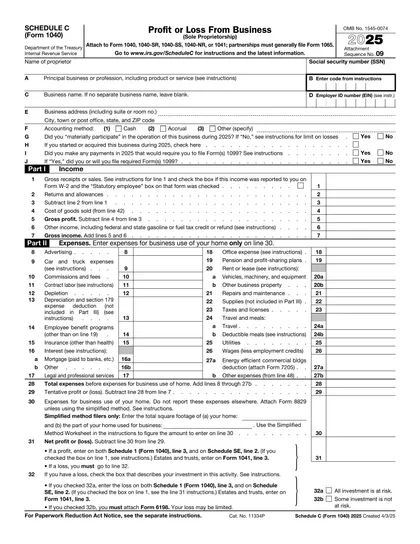
Form 8829 is filed only with Schedule C. Your total allowable home office deduction from line 36 is entered on Schedule C, line 30. Line 8 of Form 8829 uses your net income from Schedule C, line 29, to set the deduction limit.
Who uses it: Sole proprietors and single-member LLCs reporting business income and expenses.
Form 1040 / 1040-SR – U.S. Individual Income Tax Return
Form 8829 is attached to your Form 1040 through Schedule C. Your completed Form 1040, with Schedule C and Form 8829, is submitted together to the IRS by the tax return due date.
Who uses it: All individual taxpayers filing annual federal income tax returns.
Form 4562 – Depreciation and Amortization
If you are depreciating your home for business use (Part III of Form 8829), Form 4562 may also be required. The depreciation calculated on Form 8829, line 42, represents the business portion of your home's depreciation.
Who uses it: Taxpayers claiming depreciation on business assets, including the business portion of a home.
Form 4684 – Casualties and Thefts
If any portion of your Form 8829 deduction includes casualty losses (lines 14 and 33), carry the casualty loss portion from line 35 to Form 4684.
Who uses it: Taxpayers reporting losses from casualties, disasters, or thefts affecting their home or business property.
Schedule A (Form 1040) – Itemized Deductions
Mortgage interest and real estate taxes not allocated to business use on Form 8829 are still deductible as personal itemized deductions on Schedule A. The "excess mortgage interest" and "excess real estate taxes" on Form 8829 (lines 16–17) represent amounts already claimed on Schedule A.
Who uses it: Individuals who itemize personal deductions, including mortgage interest and property taxes.
Form 4868 – Application for Automatic Extension of Time to File
If you need more time to file your personal return, Form 4868 extends your deadline to October 15, which also extends the due date for Form 8829 since it is attached to your return.
Who uses it: Individual taxpayers requesting a 6-month extension to file Form 1040.