


What is a Codicil to a Will?
A codicil is a formal legal document that amends or supplements an existing last will and testament without replacing the entire will. It is attached to the original will and modifies only the specific provisions you identify. A codicil must meet the same execution requirements as the original will — it must be in writing, signed by the testator, and witnessed by at least two adult witnesses who were not named in the original will. Any amendment to a will that does not meet these requirements is not legally valid.
What is a Codicil to a Will used for?
A codicil is used for minor amendments to an existing will, such as:
- Changing or updating the executor or alternate executor
- Adding or modifying a specific bequest (leaving a particular item to a different person)
- Adding or changing the designated guardian for minor children
- Updating a beneficiary's share of the estate
- Correcting an error in the original will For major changes — revising most of the will's contents or changing the primary distribution scheme — it is generally safer and clearer to execute an entirely new will.
How to Fill Out a Codicil to Will Template

- 1
Enter the testator's full legal name and address.
- 2
Identify the existing will by its date of execution.
- 3
State clearly which provision of the original will you are amending or revoking.
- 4
State the new provision that will replace or supplement the original.
- 5
Include a clause confirming all other provisions of the original will remain in full force.
- 6
Sign the codicil in the presence of two adult witnesses.
- 7
Have both witnesses sign in your presence.
- 8
Attach the codicil to the original will and store both together in a secure location.
Signing Requirements for a Codicil to a Will
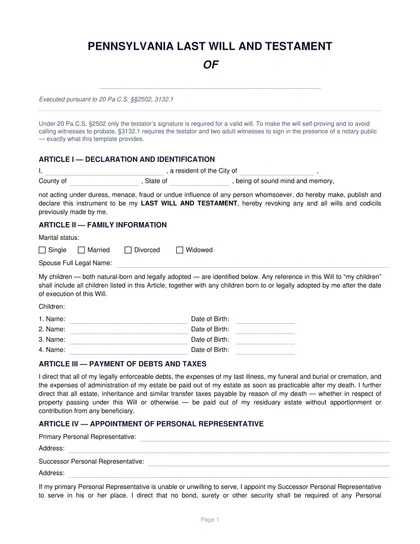
A codicil must meet the same formal requirements as the original will. In most states, this means: the testator must sign in the presence of at least two adult witnesses, both witnesses must sign in the testator's presence, and neither witness should be a beneficiary named in the will or codicil. Optional: have a notary administer a self-proving affidavit to simplify probate. States that do not require witnesses for the original will (such as Pennsylvania) apply the same rules to a codicil.
When is a Codicil Not the Right Choice?
A codicil is not appropriate when:
- You want to make major changes to the entire estate distribution scheme
- The original will has already been modified by several prior codicils (creating confusion)
- You want to change virtually all beneficiaries In these cases, executing a new, comprehensive will that explicitly revokes all prior wills and codicils is the cleaner, safer approach.
When Does a Codicil Take Effect?
Like the original will, a codicil takes effect only after the testator's death. During the testator's lifetime, the codicil — along with the will — can be changed or revoked at any time. After death, both the will and all attached codicils are submitted to probate together. The codicil modifies only the provisions it specifically addresses; all other provisions of the original will remain unchanged.
Where Can I Get a Codicil to Will Template?
PDF Guru provides a fillable, editable codicil to will template preloaded in the online editor. Open the custom template, identify the specific provisions you are amending, download a printable PDF, and execute it with the same formalities as your original will. For complex estate changes, consult an estate planning attorney before executing a codicil.
How to Sign a Codicil to a Will Online
Use PDF Guru to prepare your editable codicil template online and download a printable PDF. Like a will, a codicil must be signed in person — electronic signatures are not valid. Sign the printed codicil in the presence of your two witnesses. Both witnesses must also sign in your presence. Attach the signed codicil to your original will and store both together in a secure location.
Where to Store a Codicil to a Will
A codicil does not need to be filed with a court during the testator's lifetime. Attach the signed codicil directly to the original will and store both together in a secure location — a fireproof safe, safe deposit box, or with your estate planning attorney. After the testator's death, the executor files both the original will and all codicils with the probate court.