
Form W-4 is completed by employees to tell employers how much federal tax to withhold from their paycheck, while Form W-2 is completed by employers at year-end to report an employee’s annual wages and actual taxes withheld for tax filing.
Whether you’re an employee starting a new position or an employer managing payroll, understanding the difference between W-2 and W-4 is essential for accurate tax withholding and overall tax compliance. These IRS tax forms work together throughout the employment lifecycle, but they serve completely different purposes at different stages.
In this guide, we'll break down what each form does, when you'll need them, and how they work together in the tax process.
What is a W-4 Form?
Form W-4, officially called the Employee's Withholding Certificate, is a document you complete when you start a new job or when you want to adjust your tax withholding. This form tells your employer how much federal income tax to withhold from your paycheck each pay period.
The W-4 Form includes information about your filing status, number of dependents, and any additional income or deductions you want your employer to consider. Based on what you report, your employer calculates how much federal tax to withhold from your paycheck and sends it to the IRS on your behalf throughout the year.
You can update your W-4 anytime your financial situation changes — for example, if you get married, have a child, or take on a second job.
What is the purpose of the W-4 Form?
The purpose of the W-4 Form is to help you control how much federal income tax comes out of your paycheck and maintain proper tax compliance. Filling out a W-4 correctly helps you avoid significantly overpaying taxes during the year (leading to a large refund) or underpaying (which could result in a tax bill when you file your return).
The W‑4 Form requests basic information like your filing status, how many dependents you have, and whether you have other income or deductions. Using these details, your employer can calculate how much tax to take out of each paycheck so you don't have too much or too little withheld.
What is a W-2 Form?
Form W-2, officially known as the Wage and Tax Statement, is a document your employer provides at the end of each year that summarizes your total earnings and the amount of federal, state, Social Security, and Medicare taxes withheld from your paychecks during that year.
You should receive your copy of Form W-2 by January 31 for the previous tax year. For example, if you worked in 2025, your employer must send you a W-2 by January 31, 2026, and you’ll use this form to file your federal and, if applicable, state income tax returns.
The W-2 form shows details such as your taxable wages, Social Security and Medicare wages and taxes withheld, and may also include information such as contributions to employer-sponsored retirement plans or certain pre-tax benefits. If you worked for multiple employers during the year, you’ll receive a separate W-2 from each one.
What is the purpose of the W-2 Form?
The purpose of a W-2 Form is to report your annual income and tax withholdings to both you and the IRS. Reading a W-2 allows you to verify that your employer withheld the correct amount of taxes based on the information you provided on your Form W-4.
When you file your tax return during tax filing season, you'll use the information from your W-2 to calculate whether you owe additional taxes or are due a refund. Essentially, the W-2 is proof of what you earned and what taxes were already paid on your behalf throughout the year.

Is W-4 the same as W-2?
No, Forms W-4 and W-2 are not the same. While both forms relate to employment and taxes, they serve different functions at different times.
Form W-4 is a document you complete as an employee to instruct your employer on how much federal income tax to withhold from each paycheck. You fill out the W-4 Form when you're hired or whenever you need to update your withholding preferences.
Form W-2 is a document your employer completes at year-end to report your annual wages and the actual amount of taxes withheld. You receive the W-2 form to use when filing your tax return.
In short, the W-4 controls what happens during the year, while the W-2 reports what happened at the end of the year. Whether you use the Form W-2 or W-4 for taxes depends on whether you’re adjusting paycheck withholding or reporting income at year-end. For most employees, it comes down to filling out a W-4 and reading a W-2 at the right time — one is completed when you start a job or make changes to your withholding, and the other shows what happened by the end of the year.
Key differences between W-2 and W-4
While both forms are critical for tax compliance, understanding their distinct roles helps you manage your tax obligations more effectively. The W-4 sets your withholding expectations at the beginning of employment, while the W-2 confirms the actual results at year-end. If you’re unsure whether it’s Form W-4 or W-2 that applies to your situation, the key differences below clarify who completes each form, when each is used, and what information each contains.
Who completes each form?
W-4: Completed by the employee.
W-2: Completed by the employer.
Who receives it?
W-4: Kept by the employer (not sent to the IRS).
W-2: Sent to the employee and the IRS.
When is each form used?
W-4: At the start of employment or when updating withholding.
W-2: At the end of the tax year (by January 31).
What information is included in these forms?
W-4: Filing status, dependents, additional withholding requests.
W-2: Gross wages, federal and state taxes withheld, Social Security taxes, Medicare taxes.
How often are these forms updated?
W-4: Can be updated at any time your tax situation changes.
W-2: Issued once annually for the previous calendar year.
W-4 vs. W-2 vs. 1099-NEC
In addition to Forms W-2 or W-4, you may also encounter Form 1099-NEC if you work as an independent contractor or freelancer. Here's how all three forms compare:
| Form | Purpose | Who completes it | Who receives it | When it's issued |
| W-4 | Instructs employer on tax withholding amounts | Employee | Employer keeps on file | At hire or when updated |
| W-2 | Reports annual wages and taxes withheld for employees | Employer | Employee and IRS | By January 31 |
| 1099-NEC | Reports payments to independent contractors | Client/Company | Contractor and IRS | By January 31 |
The key distinction is your employment status. If you're an employee, you'll usually fill out a W-4 when you start the job and later receive a W-2 that shows what you earned and what taxes were withheld. If you’re self-employed or work purely as a contractor, you typically do not fill out Form W-4 for that work and, instead of Form W-2, you receive Form 1099-NEC showing what you were paid. In these situations, clients may also ask you to complete Form W-9 so they can collect your taxpayer information and issue an accurate 1099.
To learn more about the differences between employee and contractor classifications, check out our detailed guide comparing Forms W-2 and 1099-NEC.
PDF Guru helps you fill out tax forms on time
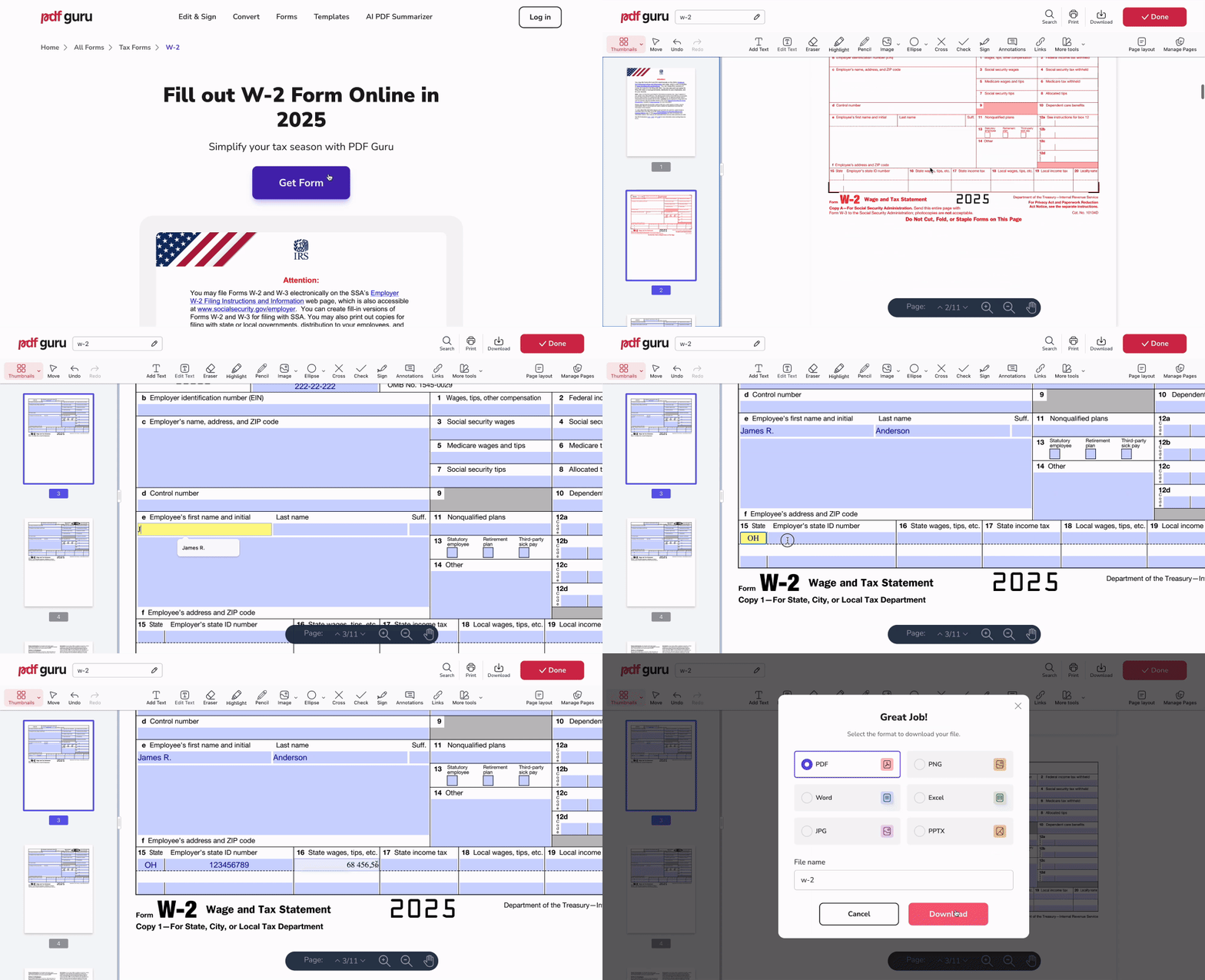
Tax season doesn't have to be stressful. With PDF Guru, you can access our extensive forms library to quickly find, fill out, and download any tax form you need — hundreds of other federal and state forms, including:
You can access both forms through PDF Guru:
Our online PDF editor makes it simple to complete forms electronically, add your information, and save your documents securely. Whether you’re filling out Form W-4 for a new job or organizing your Form W-2 documents for filing, PDF Guru streamlines the entire process so you can finish your paperwork in minutes instead of hours.