

The main difference between Forms 941 and 944 is how often they need to be filed and how much payroll tax you owe for the year. Form 941 is filed quarterly, while Form 944 is filed annually and is designed specifically for small employers with an annual tax liability of $1,000 or less.
In this article, we’ll explain how each form works and include a quick comparison table for clarity. You’ll also learn how to find and complete the forms using PDF Guru.
What is Form 941?
Form 941, officially known as Employer’s Quarterly Federal Tax Return, is a form most US business owners send to the Internal Revenue Service (IRS) every three months. It’s how they report what they paid their employees and what taxes were taken out of those paychecks. The form also includes the employer’s own share of Social Security and Medicare taxes. Today, most businesses fill out 941 online using payroll software or PDF editors like PDF Guru, which simplifies the reporting process and reduces errors.
Here is what Form 941 covers:
Employee tax withholdings: This shows the amount of federal income tax, Social Security, and Medicare tax deducted from employee paychecks.
Employer tax contributions: Employers also pay their own share of Social Security and Medicare taxes, and those amounts are reported here, too.
Tax payment tracking: A detailed breakdown of when and how much the business deposited throughout the quarter.
Available tax credits: Some employers can use Form 941 to claim certain tax credits, such as the research and development credit.
Reconciliation with annual reports: At the end of the year, the IRS checks that all four Form 941 filings match the totals shown on employees’ W-2 forms and the employer’s W-3 summary.
What is Form 944?
IRS Form 944, the Employer’s Annual Federal Tax Return, is designed specifically for very small businesses. If your annual employment tax liability is $1,000 or less and you've received IRS approval, you can file this simplified form just once per year instead of quarterly.
What Form 944 covers:
Annual employment tax reporting: All federal employment taxes for the entire tax year in a single filing.
Total compensation: All wages, tips, and other employee compensation paid during the year.
Federal tax withholdings: Income tax withheld from employee paychecks throughout the year.
Payroll tax contributions: Both employer and employee portions of Social Security and Medicare taxes.
Eligible tax credits: Certain small business tax credits that can be applied against your employment taxes.

What is the difference between Forms 941 and 944?
| Category | Form 941 | Form 944 |
|---|---|---|
| Eligibility | Most employers that pay wages subject to federal income tax, Social Security, and Medicare taxes | Small employers with total yearly employment tax liability of $1,000 or less, who are approved by the IRS to file once per year |
| Purpose | Reports wages, tips, federal income tax withheld, and employer/employee shares of Social Security and Medicare taxes | Same information as Form 941, consolidated into a single annual filing |
| Tax filing frequency | Quarterly (four times per year) | Annually (once per year) |
Note: Choosing Form 944 vs. 941 is not something you decide on your own. The IRS must send you written notification that you're eligible. If you haven't received this notification but believe you qualify, contact the IRS.
Which form do you need to file, 941 or 944?
Your filing requirement depends on your total payroll tax liability and IRS approval. Understanding the difference between 941 and 944 helps you prepare the correct paperwork and avoid filing errors.
Most businesses are required to file Form 941 quarterly to report federal income, Social Security, and Medicare taxes. You can only file Form 944 instead if the IRS sends you official notification that your business qualifies for annual filing. This usually happens when your total annual employment tax liability is $1,000 or less.
If you expect your yearly employment tax liability to be $1,000 or less, you can request approval to file Form 944 by calling or writing to the IRS.
Important: You must receive written IRS approval before switching from Form 941 to 944. Filing Form 944 without authorization can result in penalties and processing delays.
How to get blank forms 941 and 944
You can access both forms through PDF Guru:
You can also find them on the IRS website, but we store the latest IRS templates, so there’s no need to look elsewhere. With PDF Guru, you can start filling them out immediately. Our PDF editor lets you complete forms digitally, add electronic signatures, and save everything for your records — no printing required.
How to fill out Form 941 or 944 with PDF Guru
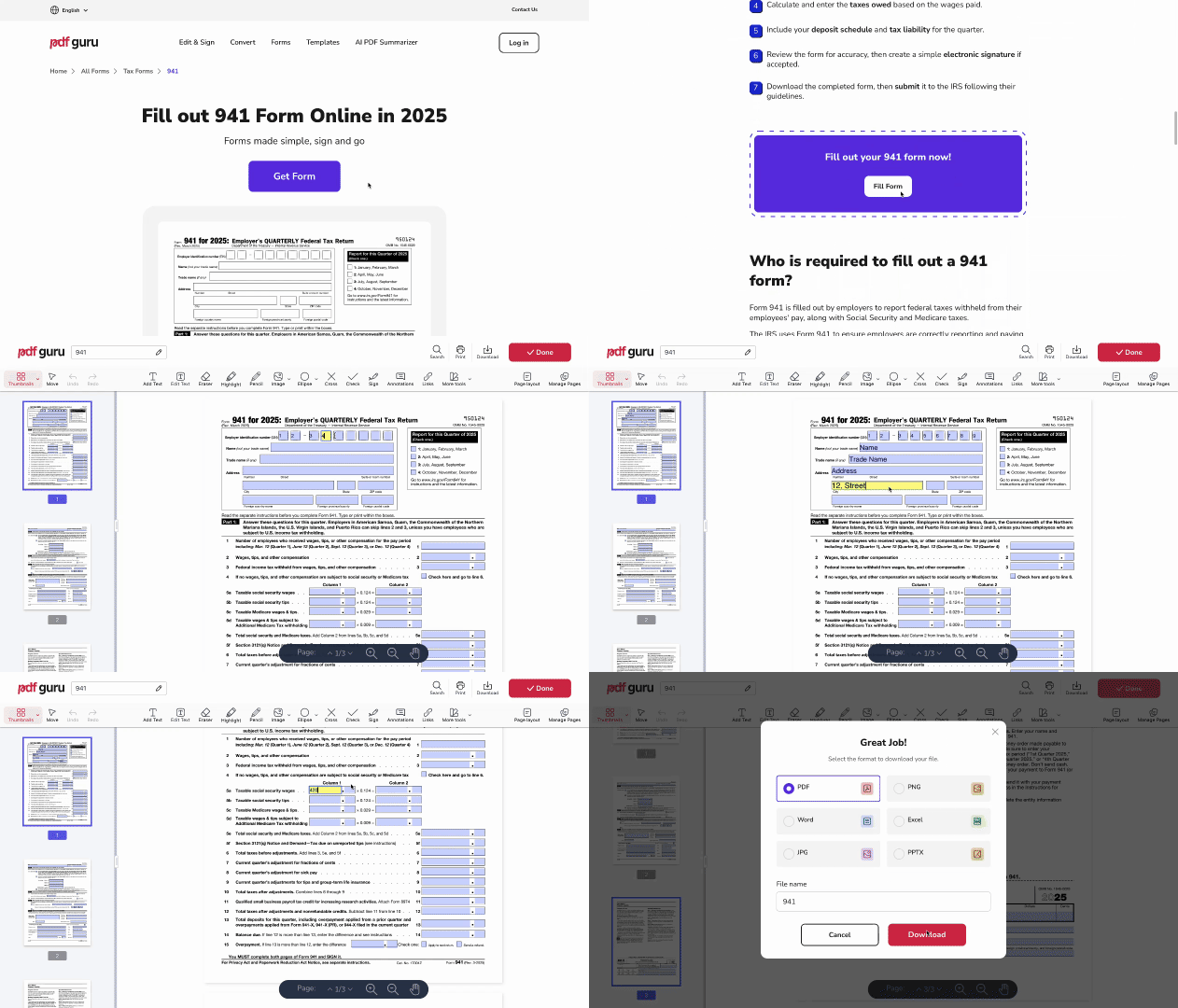
Follow these steps to complete your employment tax form:
- 1
- 2Complete all required fields. Enter your business information, wage data, tax withholdings, and deposits accurately.
- 3Review. Double-check all numbers, especially calculations and tax liability totals.
- 4Sign electronically. Use PDF Guru's signature tool.
- 5Download and submit. Save the completed form to your device and file it according to IRS instructions.
Pro tip: Before clicking "Get form," scroll down to read detailed instructions about how to complete each section, filing deadlines, and submission addresses.
For other similar documents, explore PDF Guru's Forms library. It offers ready-to-fill templates for tax, financial, legal, and business documents.
Common mistakes to avoid when filing Forms 944 and 941
Making an error on your tax return or filing it incorrectly can potentially trigger IRS notices or penalties. To avoid common mistakes when filing Forms 941 and 944, focus on accurate information and make sure to avoid these frequent errors:
- Wrong form choice: File Form 941 every quarter unless the IRS has approved you in writing to use Form 944, which is filed once a year. A tax professional can help you request this change and confirm which form you should use.
- Incorrect business information: Double-check your EIN (employer identification number), business name, address, and employee details before you submit.
- Miscalculations: Review all calculations carefully or use payroll software to ensure totals are accurate.
- Numbers on the wrong line: Check line numbers carefully; placing them incorrectly can cause processing delays or IRS notices.
How to file forms 941 and 944
Now that you know which form you need, let’s walk through how to file it. Whether you're submitting the quarterly Form 941 or the annual Form 944, the federal filing process offers both electronic and paper options.
Electronic filing (recommended):
- Use the IRS's free Electronic Federal Tax Payment System (EFTPS).
Paper filing:
- Mail your form to the IRS address specific to your state (listed in the form instructions at IRS.gov).
- Send it via certified mail so you have proof of delivery.
Making payments:
- Deposit your employment taxes electronically through EFTPS before the deadline.
- Keep in mind that same-day processing isn’t always available, so schedule payments ahead of time.
When to file Form 941 vs. 944
Form 941 is due at the end of each quarter, following the month in which it ends.*
- Q1 (January–March): April 30
- Q2 (April–June): July 31
- Q3 (July–September): October 31
- Q4 (October–December): January 31
If you deposit all required taxes on time and in full, you receive an automatic 10-day grace period.
Form 944 is due once a year, by January 31. If all taxes are deposited on time and in full, you may file as late as February 10 without penalty.
Important: These dates apply to filing the forms, not making payments. Employment tax deposits must be made throughout the quarter or year according to your assigned deposit schedule (monthly or semi-weekly). Missing a deposit deadline can trigger penalties even if your form is filed on time.
Final thoughts
Now that you understand the difference between IRS Forms 941 and 944, you know which one to use. If you still have questions about these or other forms, feel free to contact our support team at support@pdfguru.com — we’re here 24/7 to help.