

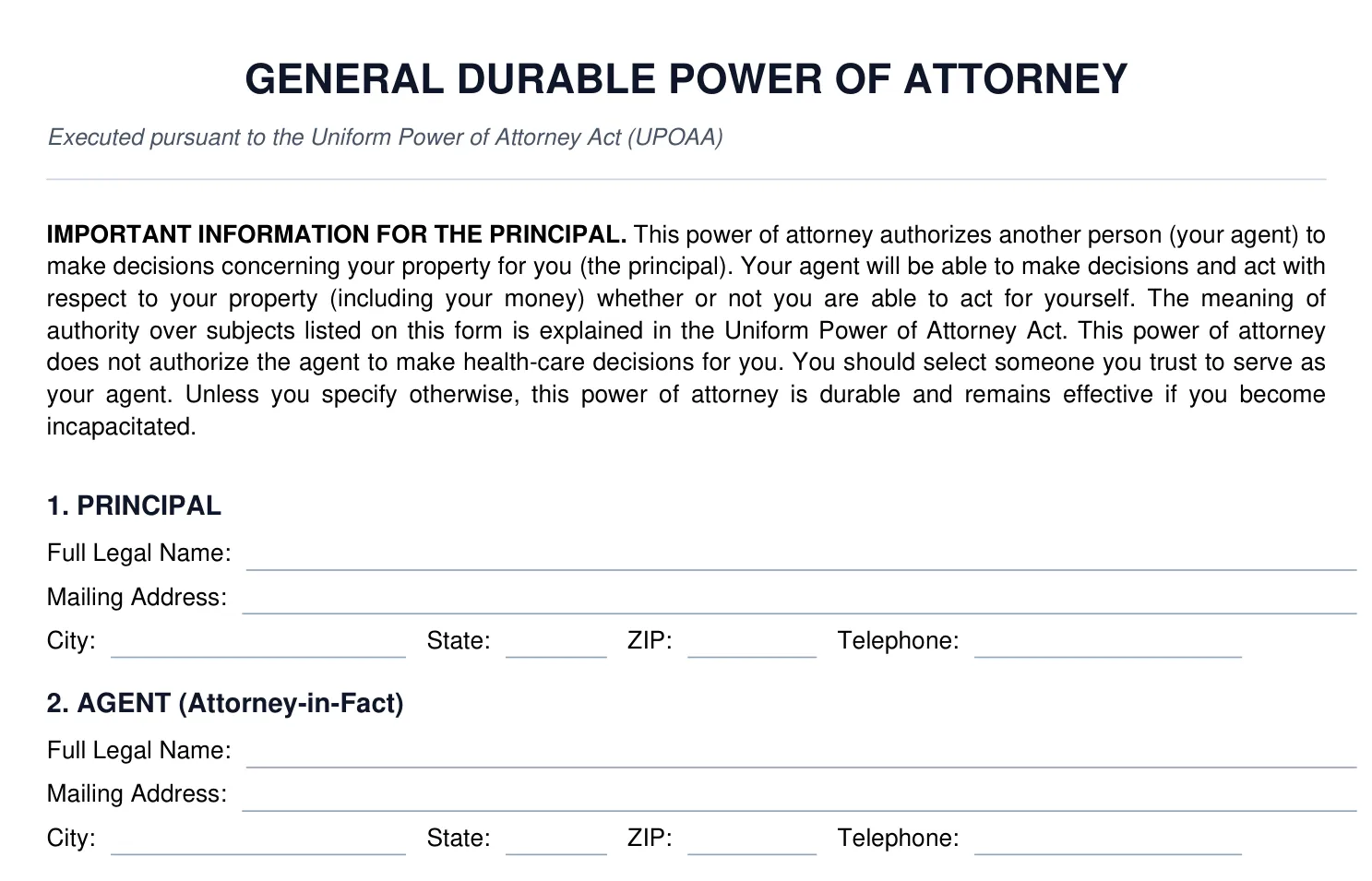
What is a general power of attorney?
A general power of attorney is a legal document that grants your designated attorney-in-fact broad authority to act on your behalf in financial and property matters. It names the principal (you), the agent, the scope of authority granted, and — when needed — a durability clause keeping it effective even if you become incapacitated.
A standard general POA terminates upon incapacity. A durable power of attorney includes language such as "this power of attorney shall not be affected by subsequent disability," keeping it valid through any period of incapacity. For estate planning and long-term security, a durable POA is the recommended choice.
What is a power of attorney used for?
A power of attorney authorizes a trusted person to manage your affairs when you cannot. Common purposes include:
- Managing bank accounts and investments in personal finance when you are unavailable or incapacitated
- Handling real estate transactions — see also our real estate forms
- Filing taxes and handling federal tax matters on your behalf
- Making health care decisions through a medical power of attorney or healthcare directive
- Overseeing business operations, government benefit applications, and retirement accounts
- Avoiding court-appointed guardianship through proper estate planning — reducing burden on loved ones and saving legal costs
Power of attorney forms by state
This page provides a general power of attorney covering the required fields used across all states. Because notarization rules, witness requirements, and accepted form language differ significantly by state, use a state-specific form if your state has particular requirements:
How to fill out a power of attorney form?
- 1
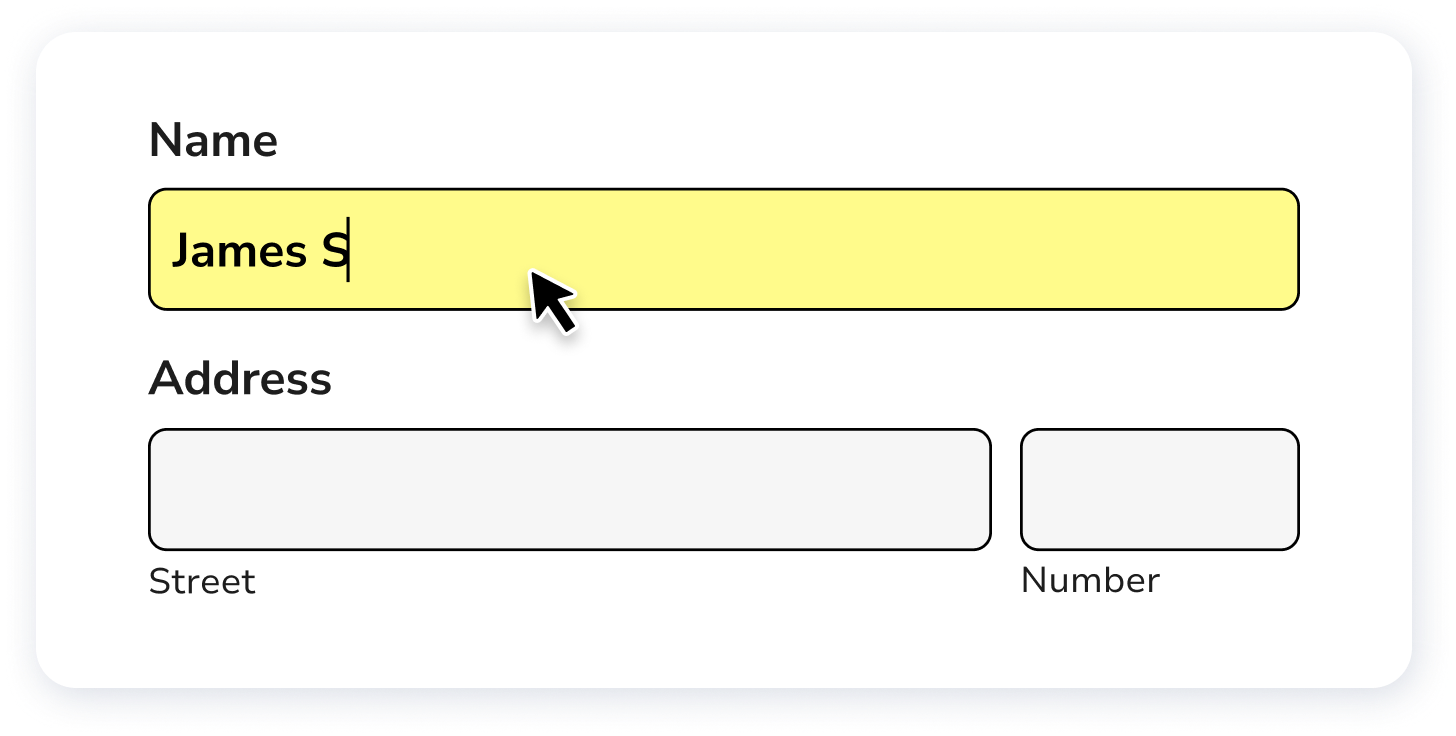
Open the blank power of attorney form: The document is preloaded in PDF Guru's editor.
- 2
Enter your details as the principal: Full legal name, address, and date of birth.
- 3
Name your agent: Full name and contact details of this person, plus any successor agent.
- 4
Define the powers granted: Banking, real estate, tax matters, healthcare, business operations, retirement accounts.
- 5
Add a durable clause if needed: Include language keeping it valid should illness or injury incapacitate you.
- 6
Set the effective date: Immediate, or springing upon a triggering event such as confirmed incapacity.
- 7
Complete notarization in person: Print and sign in person (witnesses required by your state, if any). Use the state links above to confirm local rules.
What should a power of attorney include?
A complete power of attorney document should contain the following:
- Your full legal name and address as the principal, plus the agent's name and contact information
- A successor agent who will act if the primary attorney-in-fact cannot serve
- Specific powers granted — finance, real estate, health matters, tax filings, retirement accounts
- Durability clause to keep the document effective through incapacity (if desired)
- Effective date or springing condition, any limits on the agent's authority
- Signature block, notarization acknowledgment, and witness signatures per state law
Who needs to sign a power of attorney?
At minimum, you (the principal) must sign. Requirements beyond that vary by state — some require notarization only; others require one or two witnesses alongside. In most states, the agent cannot serve as a witness — nor can their spouse or anyone who stands to benefit from the POA.
See the state-specific legal forms above to confirm what your state requires.
Does a power of attorney need to be notarized?
In most states, yes. Notarization is required for a power of attorney to be recognized by banks, real estate agencies, and government bodies. Some states also require one or two witnesses in addition to notarization; several — including California and Illinois — allow witnesses as a full alternative. For healthcare decisions, a separate medical power of attorney or health care directive may be required — see our healthcare forms for options.
Even where notarization is not mandated by statute, a notarized document will be accepted more reliably. A notary public verifies your identity, confirms you are signing voluntarily, and applies the official seal.
How long is a power of attorney valid?
A general power of attorney terminates automatically if the principal becomes incapacitated — unless a durability clause is included. A durable POA has no expiration date; it remains valid until you cancel it in writing, you pass away, or a court terminates the document. To revoke a power of attorney, sign a written notice and deliver it to that person, then notify all banks and institutions that have been relying on the POA. Estate planning professionals recommend reviewing your will and POA after any major life change.
Where can I get a power of attorney form?
PDF Guru provides a blank power of attorney form preloaded in the editor — fill it in, add your signature, and download the document as a PDF to bring to your notarization appointment. For legal forms tailored to your state, use the state links above. State court websites, bar associations, and legal aid organizations also publish their own PDF, printable power of attorney form options at no cost.
For complex situations involving significant assets, consult a lawyer before executing the document.